The Curricula
Gradus ad Montem
The Progymnasmata
A four-year composition course built on the progymnasmata, the fourteen graded exercises that trained writers from ancient Athens through the Renaissance. Each exercise is learned on a real text, and each week ends in finished writing.
What it teaches
The progymnasmata are a ladder. The student begins with the fable, the shortest story with a point, and learns to restate it, expand it, compress it, and invent one. From fable the course climbs to narrative, to the chreia and the maxim, to refutation and confirmation, to praise and blame, comparison, speech in character, and vivid description. At the summit is the thesis: a question argued on its merits, in the student's own voice.
Each exercise teaches one move, and each move is kept. A student who has learned to narrate keeps narrating when he learns to argue. By the fourth year the exercises are tools he reaches for without being told.
The handbooks themselves are the authority: Theon, Hermogenes, Aphthonius, and Nicolaus, in George Kennedy's translation, which is free to download. Model texts come from Aesop, Hesiod, La Fontaine, and the myths. Grammar is taught inside the writing, not beside it.
The first year
Year 1 runs 36 weeks in four units, with review, declamation, and exam weeks between them.
- Fable · Weeks 1–6
- Narrative · Weeks 7–15
- Chreia · Weeks 19–26
- Maxim · Weeks 27–34
Weeks 16–18 and 35–36 are for review, a declamation recited before an audience, and the semester and final exams.
The shape of a week
One teaching day and three independent days. Day 1 can be taught at home or in a co-op class; the Teacher Guide gives a plan for each.
| Day | Work | Time |
|---|---|---|
| Day 1 | Lesson with the teacher: recitation, the model text and narration, the form taught and analyzed, grammar, and literature discussion. | 75 min at home · 90 min in co-op |
| Day 2 | Copywork, style, grammar, and an outline of the week's composition. | about 45 min |
| Day 3 | The composition, drafted from the outline. | about 45 min |
| Day 4 | Revision, dictation, and the final copy, read aloud. | about 45 min |
The teacher prepares for about 20 to 30 minutes a week.
For the parent who teaches it
The Teacher Guide gives a background note for every week, a full answer key, and a sample composition for every assignment, so that grading has a fixed star. It follows Theon's own advice on correction: in the early weeks, mark no more than three problems in a composition, and always name one thing done well.
The writing must be the student's own, from plan to final copy. The course is built so that it is: every piece is read aloud and talked through in conference, and the exams are timed compositions that no one else can write.
At a glance
- Who it's for
- High school students, beginning in ninth grade. Works at home or in a co-op.
- Credits
- English, four years.
- Transcript name
- English I: Literature and Composition — Classical Rhetoric I
- In the box
- Student Workbook · Teacher Guide · optional pre-printed commonplace journal
- Also needed
- Kennedy's Progymnasmata (free PDF), a Bible, inexpensive editions of Aesop and the myths, and three notebooks.
- Works with
- Stands alone. The Craft of Memory runs on the same calendar and stores what this course writes with.
Sample pages
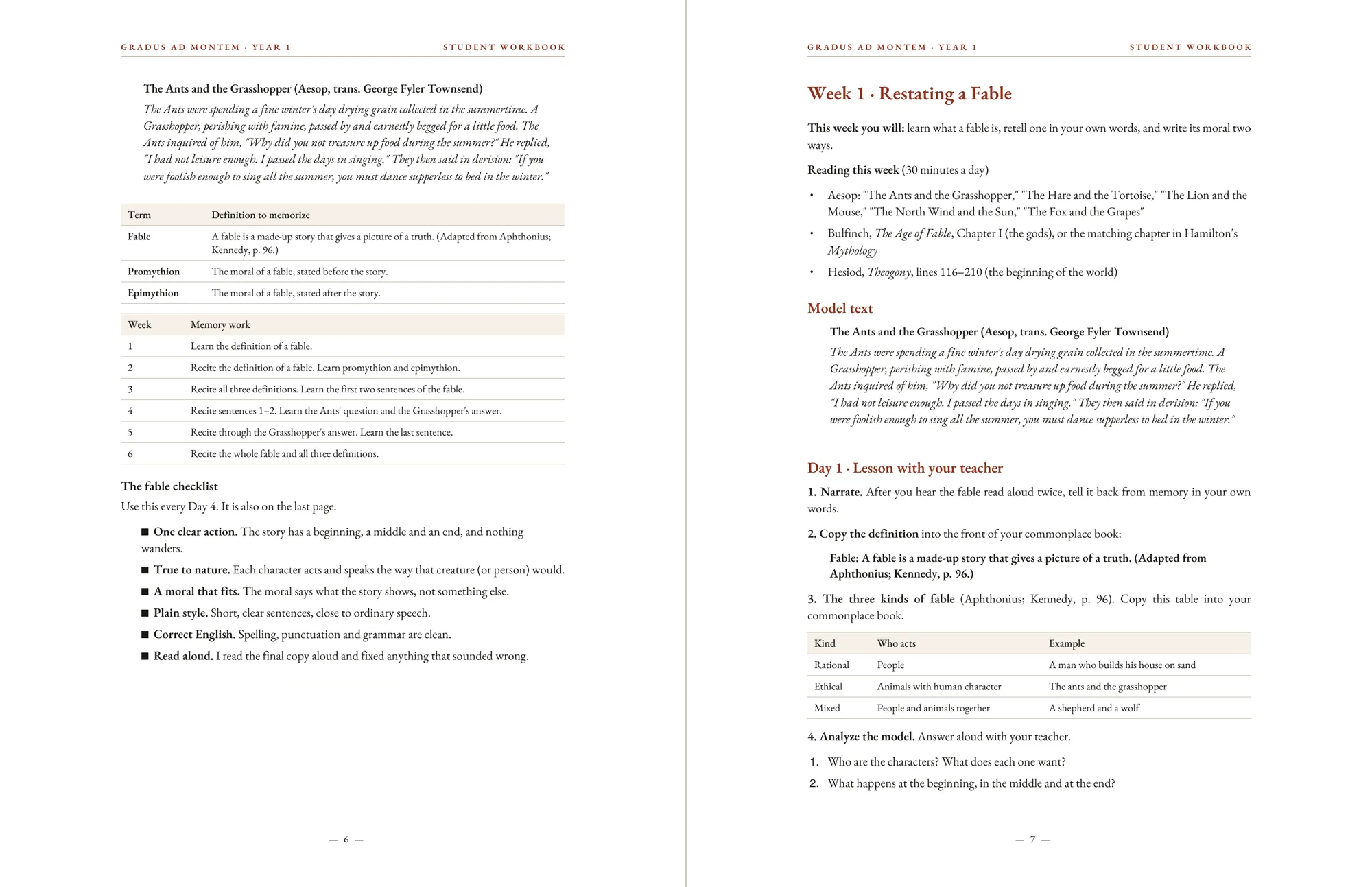 (open larger image)
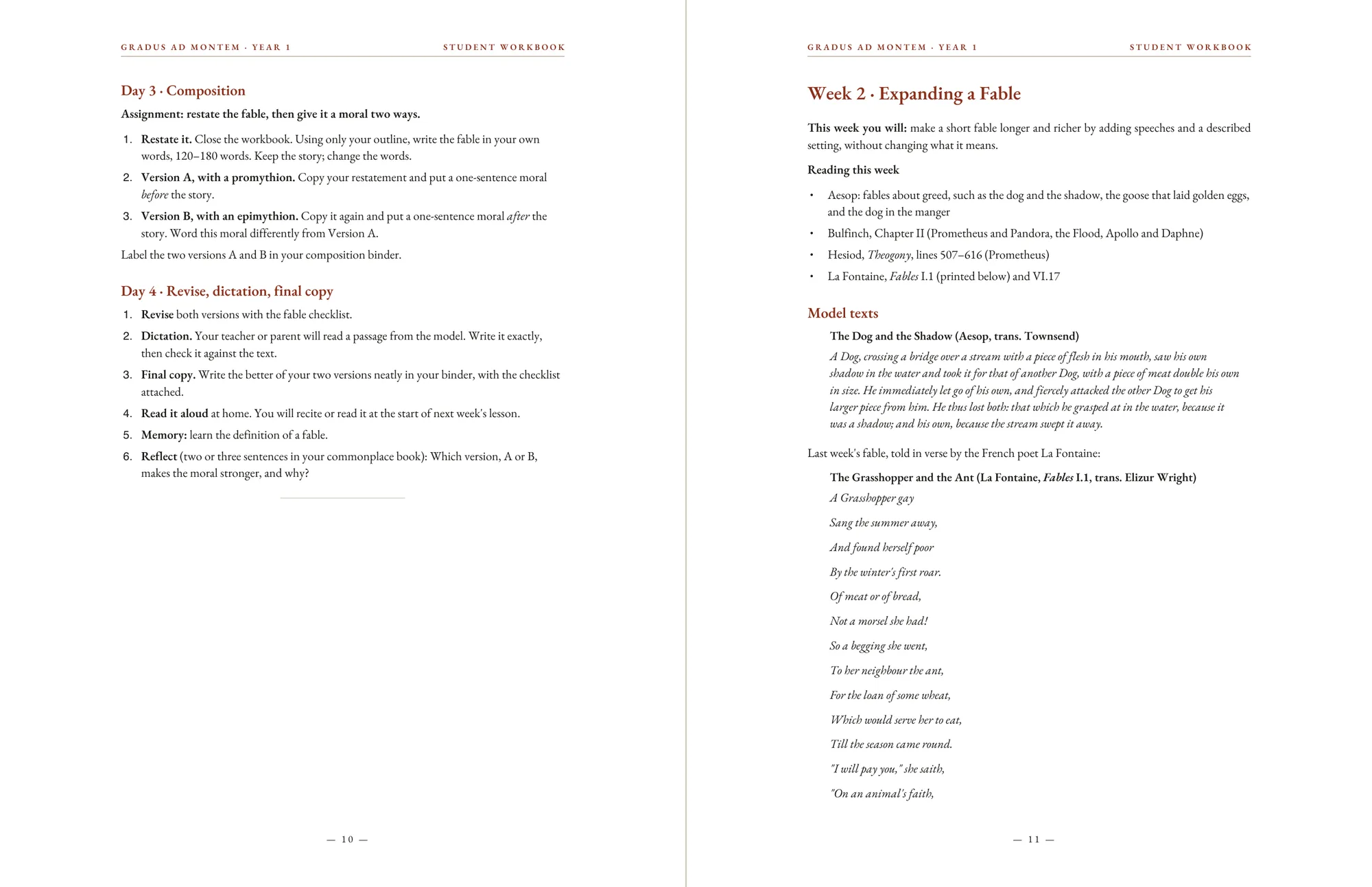 (open larger image)
- Year 1 · Student Workbook (excerpt) PDF · 14 pages · 1.2 MB
- Year 1 · Teacher Guide (excerpt) PDF · 15 pages · 1.3 MB
Follow the pilot
Join the interest list for sample pages as they are finished, word when pilot spots open, and release and pricing news when there is some.
Join the interest list